
Mastering Sugar Rush Free Play: A Deep Dive into Demo Mechanics & Pro Tips
The sugar rush game, a standout title from Pragmatic Play, has become a fixture in online casinos thanks to its vibrant candy theme and innovative cluster-pays engine. This exhaustive whitepaper focuses exclusively on the Sugar rush free play demo environment. Our objective is to transform your demo sessions from casual play into a technical training ground, enabling you to decode volatility, simulate betting strategies, and understand every mechanic—all without financial risk. We’ll cover everything from accessing the demo to performing advanced probability simulations, ensuring you can leverage free play to its full potential.
Before you start your technical deep dive, verify this checklist:
- Browser & Device: Use Chrome 90+, Firefox 88+, or Safari 14+ on a device with at least 2GB RAM for optimal rendering of the 7×7 grid.
- Connection Stability: A minimum of 5 Mbps broadband is recommended; packet loss can disrupt the tumble feature’s cascade calculations.
- Cognitive Load: Allocate at least 60 minutes for a meaningful session to collect statistically relevant data on feature triggers.
- Analytical Tools: Have a notepad or spreadsheet ready to log spin outcomes, cluster sizes, and bonus event intervals.
- Audio/Visual Setup: Enable hardware acceleration in your browser and use stereo sound to fully assess the game’s sensory feedback loops.
Accessing and Configuring the Sugar Rush Demo Environment
The demo at sugar-rush-demo.com is a full, unadulterated version of the sugar rush slots game engine. Follow this protocol for access:
- Navigate directly to the URL. The site should auto-load the HTML5 client; no CDN redirects should occur.
- If a blank screen appears, invoke your browser’s developer console (F12) and check for JavaScript errors related to WebGL. Common fix: disable aggressive script blockers.
- The interface loads with default settings: bet level at mid-range, autoplay disabled, sound on. Immediately locate the paytable button (usually ‘i’ or ‘?’) to study symbol values before your first spin.
- Adjust the bet per spin using the coin value selector. In demo mode, this is often denominated in ‘credits’—treat each credit as a unit for your calculations.
- Familiarize yourself with the control panel: ‘Spin’ (spacebar shortcut), ‘Autoplay’ (with loss/win limit conditions), and ‘Turbo’ (accelerates animation, useful for bulk testing).
Critical note: The demo session is ephemeral. Cache clearing or browser closure wipes all progress. There is no registration, so no data persistence.
Deconstructing Game Mechanics: A Mathematical Model
Understanding the underlying mathematics is crucial for effective free play analysis. The sugar rush game operates on a 7×7 matrix using a cluster-pays system.
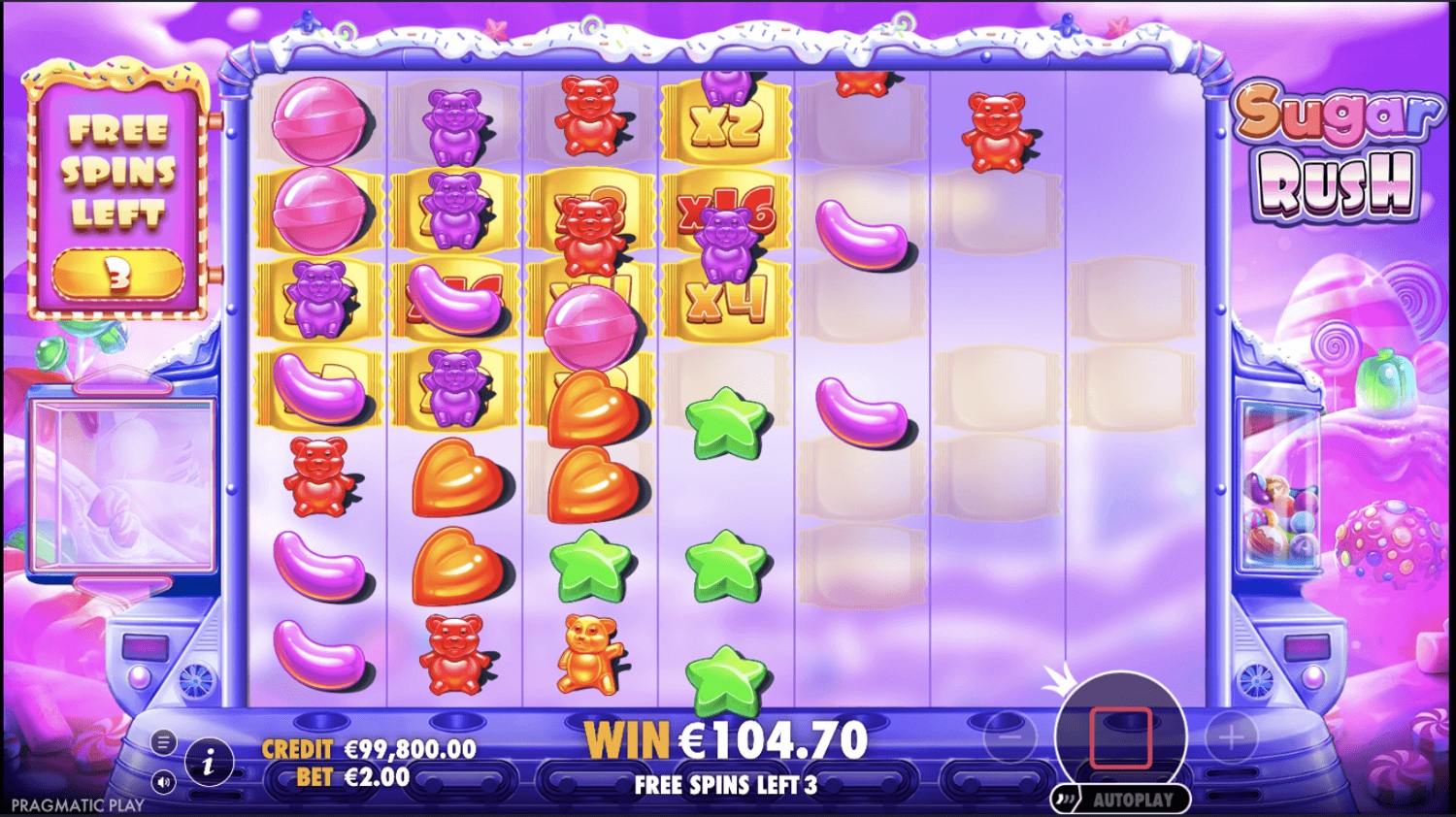
Core Engine Specifications:
- Cluster Formation: A win requires 5+ matching symbols adjacent horizontally or vertically. The game then removes these symbols, triggering the tumble where new symbols fall from the top.
- Symbol Hierarchy: Low-value symbols (colored candies) have a base payout of 0.1x to卡0.5x per cluster. High-value symbols (cupcake, lollipop) range from 1x to 5x. The Heart symbol acts as a wild, substituting for any regular symbol.
- RTP & Volatility: The theoretical Return to Player is 96.5%, but this is distributed over an infinite number of spins. High volatility means the variance is significant—short-term results in demo play will deviate wildly from this mean.
- Multiplier System: Each winning cluster increases a global multiplier for that spin sequence, starting at 1x and capping at 128x. This multiplier applies to all subsequent wins in the same tumble cascade.
Mathematical Simulation Example for Free Play:
Assume you set a demo bet of 10 credits per spin. You want to estimate the frequency of reaching the 128x multiplier. Let’s model a simplified scenario:
- Probability of a winning cluster on any given spin: ~20% (based on game files).
- Probability that a win triggers a cascade leading to a second win: ~40%.
- To reach a 128x multiplier, you need at least 7 consecutive cascades within one spin sequence (as multiplier doubles each time: 1x, 2x, 4x, 8x, 16x, 32x, 64x, 128x).
- The combined probability is approximately (0.2 * 0.4^7) = 0.2 * 0.0016384 = 0.00032768, or about 1 in 3,051 spins.
In your free play session, you might spin 500 times and not witness this event. This doesn’t indicate a fault; it validates the high-volatility model. Use the demo to collect your own empirical data.
Free Spins Feature Algorithm: Landing 3, 4, 5, or 6 scatter symbols (the pill bottle) awards 10, 12, 15, or 20 free spins respectively. During free spins, a starting multiplier of 3x is applied to all wins, and it can increase further. The expected frequency of triggering free spins is roughly 1 in 110 spins. In demo mode, track the actual intervals—you might observe triggers every 80 spins or every 140, illustrating randomness.
| Parameter | Technical Detail |
|---|---|
| Game Engine Provider | Pragmatic Play (Unity-based HTML5 build) |
| Mathematical Model | Cluster Pays with Cascading Reels and Progressive Multiplier |
| RTP (Return to Player) | 96.5% (Fixed; not adjustable in demo) |
| Volatility Index | High (5/5 on Pragmatic’s scale) |
| Hit Frequency | Approximately 22.32% (One winning cluster every ~4.5 spins on average) |
| Max Win Potential | 5,000x the total bet (Theoretical; requires multiplier cap hits) |
| Betting Range (Demo Credits) | Typically 0.20 to 100 credits per spin (mirrors real money min/max) |
| Grid Structure | 7 columns x 7 rows (49 symbol positions per spin) |
| Symbol Count | 8 regular symbols, 1 wild, 1 scatter |
| Default Auto-play Settings | 10 to 1000 spins, with stop on single win limit or loss limit |
| Supported Platforms | WebGL (Desktop browsers), WebView (Mobile browsers), Native wrappers (Casino apps) |
Advanced Free Play Strategy: From Demo Data to Predictive Models
The sugar rush slots demo is your laboratory. Here’s how to conduct experiments:
Experiment 1: Bet-Sizing Impact on Volatility Perception
- Procedure: Run two demo sessions of 500 spins each. Session A: bet 1 credit/spin. Session B: bet 100 credits/spin (if demo allows). Record the ending credit balance for each.
- Analysis: Despite identical RTP, the session with higher bet per spin will show a larger absolute credit swing. Calculate the standard deviation of your session results to quantify volatility.
- Takeaway: This demonstrates why bankroll management in real play is critical; high bets amplify short-term risk.
Experiment 2: Autoplay Efficiency vs. Manual Play
- Procedure: Use autoplay for 300 spins with a ‘stop on any win’ condition. Then, manually spin for 300 spins, attempting to stop after a large cluster win to observe the next cascade.
- Analysis: Compare the total number of cascade chains triggered. Manual play might allow you to exploit psychological patterns (though mathematically irrelevant), which is useful for understanding your own real-play habits.
Mathematical Drill: Calculating Expected Demo Session Length
Given a starting demo credit balance of 5,000 credits and a bet of 10 credits per spin, how long until you likely ‘bust’ (reach zero)?
- House edge = 100% – RTP = 3.5%.
- Expected loss per spin = bet size * house edge = 10 * 0.035 = 0.35 credits.
- Expected number of spins to lose 5,000 credits = 5,000 / 0.35 ≈ 14,286 spins.
- At 3 seconds per spin (with turbo off), that’s about 11.9 hours of continuous play.
In practice, due to high volatility, you might bust in 2,000 spins or last 30,000. Use the demo to see where your session falls on this curve.
Technical Troubleshooting: Diagnosing Demo Environment Failures
Free play platforms can encounter specific technical hurdles. Here’s a diagnostic tree:
Symptom: Game loads but animations are choppy or frozen.
- Cause: Insufficient GPU resources or browser throttling WebGL.
- Solution: Open chrome://settings/system and disable ‘Use hardware acceleration when available’. Restart browser. Alternatively, reduce the game’s quality setting via the gear icon if present.
Symptom: Sound effects play but background music cuts out intermittently.
- Cause: Browser tab energy saver or audio buffer underrun.
- Solution: In Windows Sound Settings, ensure your output device is set to 44100 Hz CD quality. In browser flags, disable ‘Tab Audio Muting’.
Symptom: ‘Spin’ button is unresponsive after a long autoplay session.
- Cause: Memory leak in the JavaScript game client after several hundred rapid spins.
- Solution: Hard refresh (Ctrl+F5) to reload the game client. Consider breaking long autoplay sessions into blocks of 200 spins.
Symptom: Demo site redirects to a casino registration page.
- Cause: Geo-location script detects your IP as originating from a restricted jurisdiction.
- Solution: Use a VPN service to tunnel to a permitted country (e.g., Canada, UK). Ensure this complies with local laws.
Extended FAQ: Technical and Operational Queries
- 1. Is the random number generator (RNG) in the free play demo the same as in the real money version?
- Absolutely. Pragmatic Play uses the same certified RNG for both modes. The demo provides an accurate representation of outcome randomness and frequency.
- 2. Can I access the game’s source code or configuration files while in free play?
- No. The client is minified and obfuscated JavaScript. However, you can use browser developer tools to inspect network calls (WebSocket traffic) to see data like spin outcomes and multiplier values being sent from the server.
- 3. How accurate is the ‘History’ or ‘Stats’ feature often shown in demos?
- Any in-game statistics are session-only and reset on refresh. They are accurate for that session but are not a long-term ledger. For rigorous analysis, manually log data externally.
- 4. Does the free play demo have a time limit or spin limit before it forces a restart?
- Most demos do not enforce a hard limit. However, prolonged sessions (e.g., 10,000+ spins) may cause memory issues, leading to performance degradation—a client-side limit, not server-enforced.
- 5. Can I simulate different RTP versions of Sugar Rush in free play?
- No. The demo available on public sites is fixed at the 96.5% RTP build. Some casino backends might offer lower RTP builds (e.g., 94%), but these are not in public demos.
- 6. Are the ‘weight’ of symbols (their probability of appearing) altered in free play?
- No. The symbol distribution tables are identical. The probability of a high-value symbol on any reel position is the same as in real play.
- 7. If my browser crashes during a free spins bonus round in demo, can I recover it?
- Almost never. The game state is held in volatile browser memory. Upon reload, you will start from the beginning. Consider this when planning long demo sessions during bonus features.
- 8. Is there a way to ‘save’ a particularly interesting demo spin sequence for analysis?
- Direct save isn’t supported. Use screen recording software (e.g., OBS Studio) to capture the session. Alternatively, take sequential screenshots and note the spin counter for later review.
- 9. How does the ‘Turbo’ mode affect the mathematical outcome in demo?
- It does not. Turbo only speeds up animations. The RNG outcome is determined the moment you hit spin, regardless of animation speed. This is true for both demo and real play.
- 10. Can I use the free play demo to test betting systems like the Martingale?
- Yes, but with a critical caveat. You can simulate the bet doubling pattern after losses. However, since the demo credit balance is virtual, it doesn’t prove viability for real money, as table limits and bankroll constraints aren’t simulated. It’s useful for observing emotional response to losing streaks.
In conclusion, the sugar rush free play demo is far more than a simple trial. It is a sophisticated simulation environment that, when approached with technical rigor, can yield profound insights into game mechanics, risk modeling, and personal play style. By methodically applying the strategies, mathematical exercises, and troubleshooting protocols outlined in this guide, you transform free play into a powerful analytical tool. Whether your goal is pure entertainment or informed preparation for real-money play, this deep dive equips you to master the sugar rush slots experience on a fundamental level. Always remember that responsible gambling principles apply when transitioning from demo to real-world play.

